
Andy is Dandy
Or, More on Warhol

Andy Warhol began his artistic career as a freelance illustrator for fashion mags like Glamour and Harper’s Bazaar. For them, he drew a lot of shoes. Andy’s own shoes stood out in his portrait by Alice Neel, so it seems he had an affinity for footwear.
Andy had his first gallery show in NYC in 1952. From there, he climbed the art ladder, refining his style and his message. Once he nailed down those two tenets—screen printing and the repetition of images—Andy never budged from their exploration.
And exploitation.
Andy always saw art as commerce, possibly because of his start as a commercial artist. The commerce of art and its making is why he called his studio The Factory. Andy was never shy about the fact that he made art to make money.
But he also had a message. Even in the 1950s, Andy knew that if viewers saw an image often enough, the picture would lose its impact. His earlier canvases explore this idea through grisly newspaper images of car wrecks and electric chairs. And movie stars.
To achieve the effect of ennui, he screen-printed images in rows. They were meant to be read like books—upper left to lower right, line by line. Andy’s theory was that by the time a viewer got to the last image, they would be inured to the once-awful image. And he was right.
Andy clearly foresaw how numb we would become to horrific images—towers falling and bombs exploding. That, to me, was his genius. And it’s the general public’s most forgotten part of Andy Warhol—that he was a genius.
He played the part of the vapid artist like a Broadway role. But it wasn’t who he was. He was smart. And he was sought after. Which brings us to this portrait
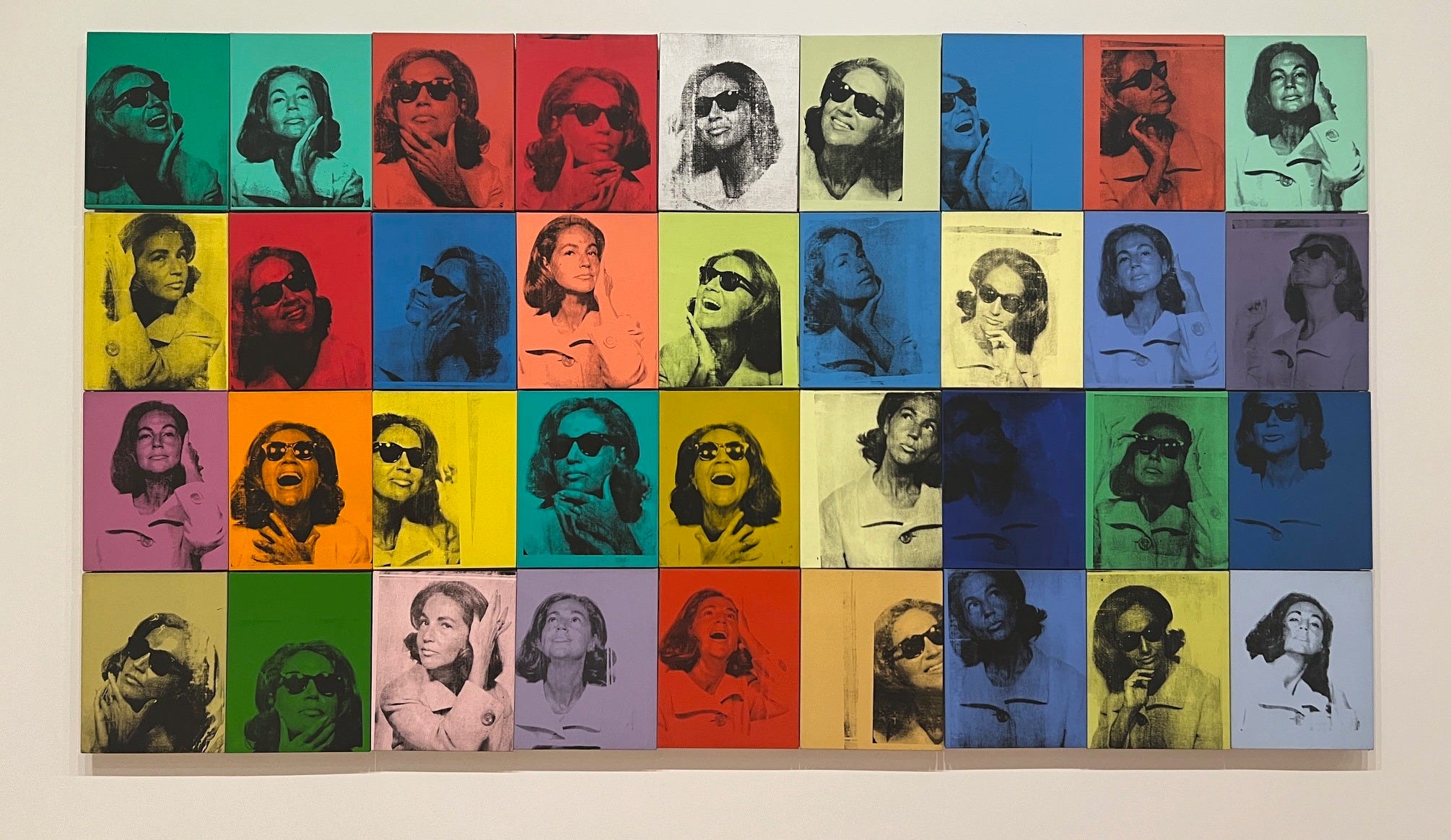
“Ethel Scull 36 Times” was commissioned in 1963 by Ethel’s husband to celebrate her 42nd birthday. Ethel’s husband wanted Andy to do a piece similar to his recent Marilyn Monroe portraits. For those, Andy used images he’d found in print media.
But for Ethel, he needed his own pictures.
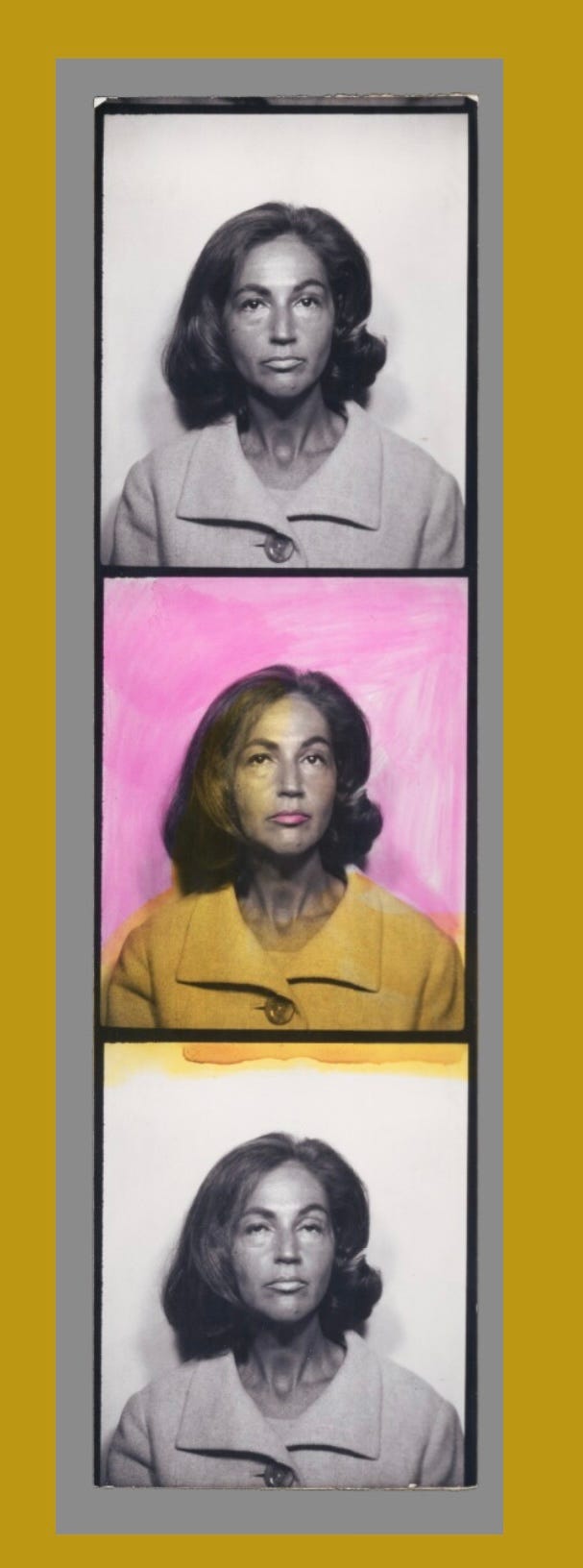
The story goes that at the appointed hour for her sitting, Andy arrived in a car and picked up Ethel. She expected to be taken to The Factory. Instead, Andy took her to a Times Square photobooth.
There, Andy fed coins in to the slot while Ethel posed. He called encouragements to make Ethel laugh, relax, and glam up her poses. Afterward, he took the photostrips back to The Factory and laid out the portrait.
Years later, the Warhol Foundation donated the strips to the Getty Museum in LA.
Interestingly, when they divorced, Ethel and her husband both claimed ownership of her portrait. And they each promised it to a different museum. Therefore, every five years, “Ethel Scull 36 Times” migrates across town from the Whitney to the Met. Talk about joint custody.
Art folks disagree about how many photostrip images of Ethel appear in the portrait. Some say each one is different; others claim some images repeat, flipped or cropped. Either way, the portrait works to prove Andy’s artistic theory—by the time we get to the end of the last row, we’re kind of numb to Ethel’s face.
Also, the repetition doesn’t tell us much about Ethel as a person. At least not in the way Alice Neel’s portrait of Andy exposed so many of his personal details. That might be the difference between a classical and a pop art portrait. One makes you think—the other’s more like eye candy. But what a treat it was to see Ethel in the Whitney.
I love the stories behind portraits—more than who owns the painting and why, but also the sitter’s relationship to the artist. This type of art appreciation inspired my debut chapbook of poems, The Higher Call, out in print in August.
Stayed tuned for news about where I’ll appear for readings and events.
And as ever, thanks for following along on my journey into print.

The Higher Call: Click this to order
I love learning little details like this art with shared custody--fantastic! I still haven't been to the Whitney. We just visited the Guggenheim for the first time earlier this month and saw a few Warhol pieces. My husband was immersed in a neon one.
I never knew Andy created art. Awesome article, thanks for sharing!