The Higher Call Inspo V
Or, How Do You Like Me Now?

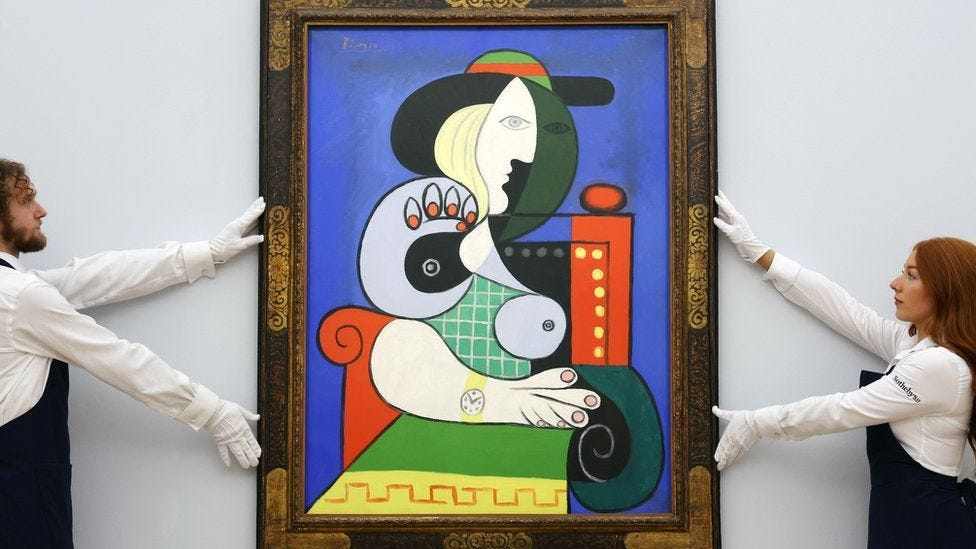
Here we see the second most expensive Pablo Picasso painting sold to date. If you’re following along at home, you recognize his Golden Muse, Marie-Thérèse, in her 1932 portrait, “Femme à la montre,” or “Woman with a Watch.”
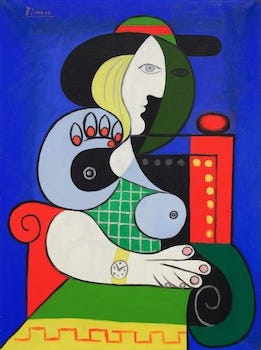
In this lovely Cubist portrait, we see Maria-Thérèse lovingly presented by her lover at the age of 23, @6 years after their affair began. And if you’re following along at home, you notice this portrait is from the same year as last week’s inspo piece.
That’s why Marie-Thérèse is called his Golden Muse—Picasso painted her a lot.
The story goes that Picasso bought her a watch, and that watch is what Maria-Thérèse wears on her wrist in this painting. She faces the viewer, but the Cubist portrait shows her profile. Her arm with the watch rests on her lap, and model-wise, this would be an easy pose to hold—seated in a chair facing forward.
Marie-Thérèse posed like this a lot. We’ll see another below.
My poem about this painting discusses the fame this portrait has enjoyed. And by association, Marie-Thérèse herself. We know her name today because Picasso painted her. And because of him, her name still rings out in auction houses. Most recently in 2023 when a $140. million bid at Sotheby’s bought her portrait wearing a watch.
I wrote about this painting even though it does not appear in the postcard book from the Musée National Picasso in Paris that inspired my debut chapbook, The Higher Call. As mentioned last week, Picasso didn’t give the state museums his masterpieces. And this portrait, he must have known at the time, was a masterpiece.
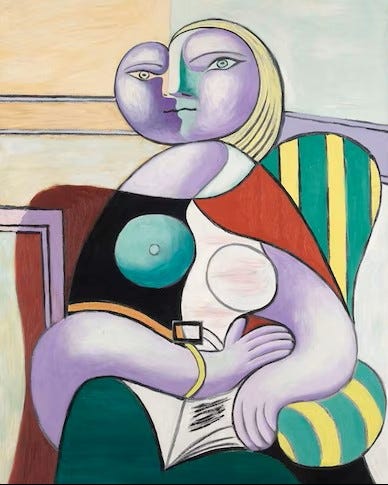
The painting that was in the postcard book is “Reading,” seen above. Even though she’s not named it in, we all recognize Marie-Thérèse.
This portrait is also from 1932, and it also shows her seated in a chair. She also appears to wear a watch on her right wrist that also rests on her lap.
These similarities make it appear that “Reading” may have inspired “Femme à la montre.” The poses are nearly identical, as are the yellow and green stripes. Marie-Thérèse wears an interesting hat in the watch painting where the composition has been refined. The book has been removed, and the background has been simplified.
I would hazard a guess that “Reading” came first. Studying it, Picasso saw how it could be improved. By refining that portrait and intensifying the colors, Picasso created the masterpiece, “Femme à la montre.”
The beauty in these paintings, and the joy a model feels posing for a talented artist—to be painted this beautifully, this masterfully—might have made it hard for a young woman to leave Picasso. That’s the tension explored in my prose poem “Maria-Thérèse Wears a Wristwatch.”
To read that poem in August, you can pre-order a copy of my chapbook, The Higher Call. I would love to sell 30 more copies. If you have not bought one yet, for about $20 you can help me reach my goal and support me on my journey to print.
Click here to pre-order a copy: The Higher Call
I’ll be away for a few weeks, but then I’ll turn to my own time on the model’s stand and how that inspired my poems in the collection. Stay tuned. I’ll be back May 25.