
More Eyes on This Me
Or, This Portrait’s Origin Story

One of the most wonderful benefits of being a model is when an artist gifts me with their work. It doesn’t happen often, so when it does, it’s an enormous honor, and a rare treat.
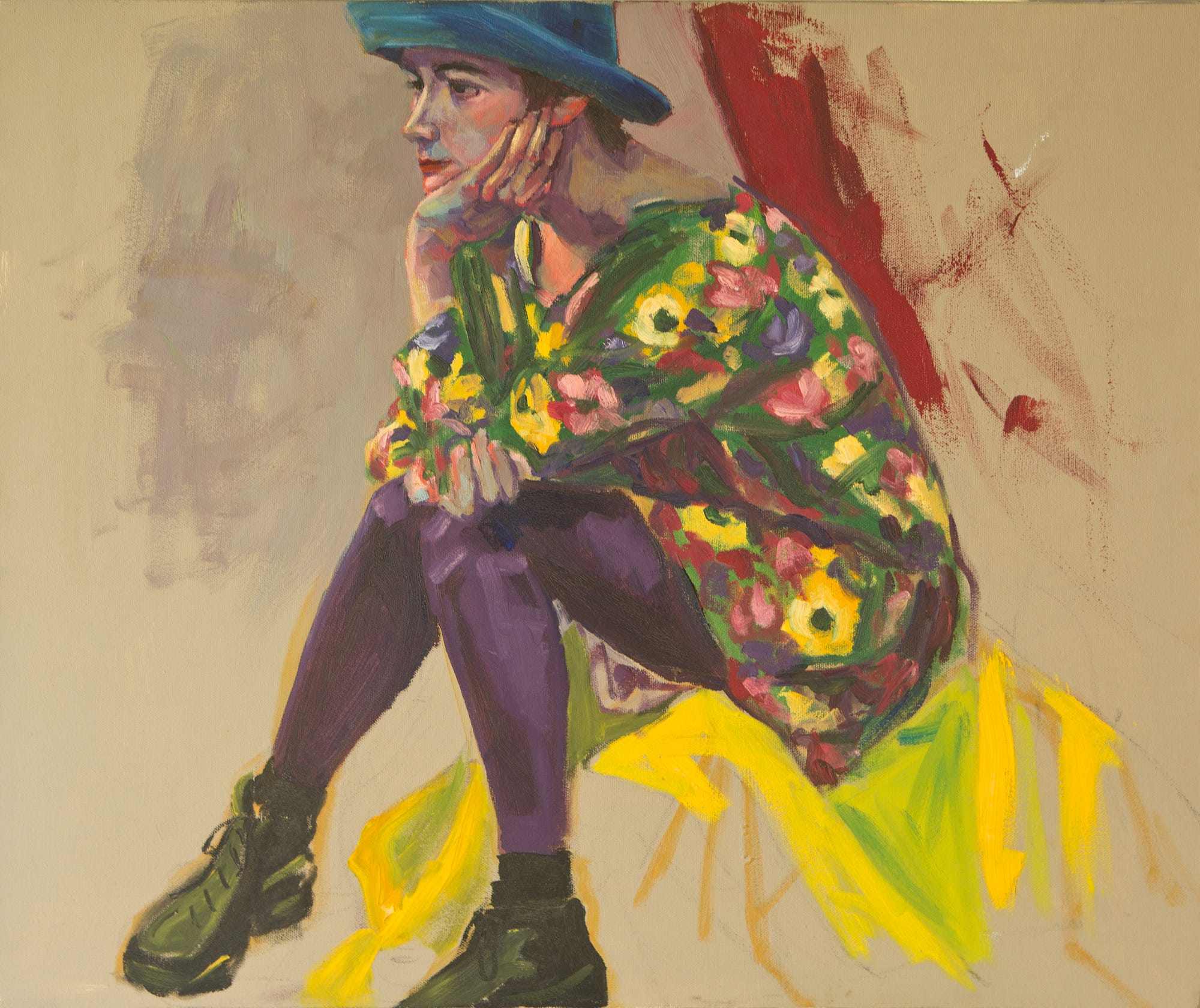
That’s how I came to own this portrait done of me in Atlanta, mid-90s. The job was at Callanwolde Art Center, but I don’t remember the name of the instructor, or the student who gave me her painting. But I remember other details.
I remember that I arrived at the studio dressed in this outfit—low-top knock-off Doc Martins, denim bucket hat, purple tights, and a flowery dress. When I asked the instructor if I should go change—meaning, to get out of my clothes and into my robe—she said, “Would you model in what you’re wearing?”
In the moment, I thought that was ridiculous. But these days I see what she meant. It’s a pretty “arty” outfit, one with nearly everything a portrait painter finds fun to paint—a hat that shows the face, interesting shoes, and vibrant fabric.
As far as modeling goes, it is easier clothed. Nude on the stand, it can be a challenge to place your legs in an interesting way that doesn’t expose parts best kept private. This can be worrisome, especially if a class completely circles the model stand.
This pose should have been easy—clothed and seated. But it wasn’t. I made a mistake.
Can you spot it? I’ll give you a hint: it’s my head resting in my right hand. It’s the bend in my wrist tasked to hold the weight of that bowling ball for hours on end. At first glance, it doesn’t seem like a hard pose to hold. But it hurt. A lot.
After 30 minutes, I knew I’d made a mistake. But it was too late. The students only had me for this one class, and it was only three hours long. 30 minutes was a chunk.
By then, they’d already blocked me in on their canvases—placed and sketched and ready to paint. There was no going back. I was stuck with it, and I stuck with it.
I took breaks, every 25 minutes. But I couldn’t hold the pose that length of time without shaking out my wrist every so often. Especially toward the end. The end of class is when a long pose makes itself known. That’s when a model earns her money.
Even with all that, the student created a great portrait. She laughed when I gushed over it after class. She thought she’d made mistakes. But I don’t see them.
I see me mid-90’s while earning my MFA in Poetry, wearing my sister’s maternity dress that her mother-in-law sewed when my sister was pregnant with her daughter.
Every portrait has such stories behind it—the story of the model’s time on the stand, the story of the props the artist choses to include, the story about the artists and how they were to work with. These behind-the-scenes stories get captured in paint.
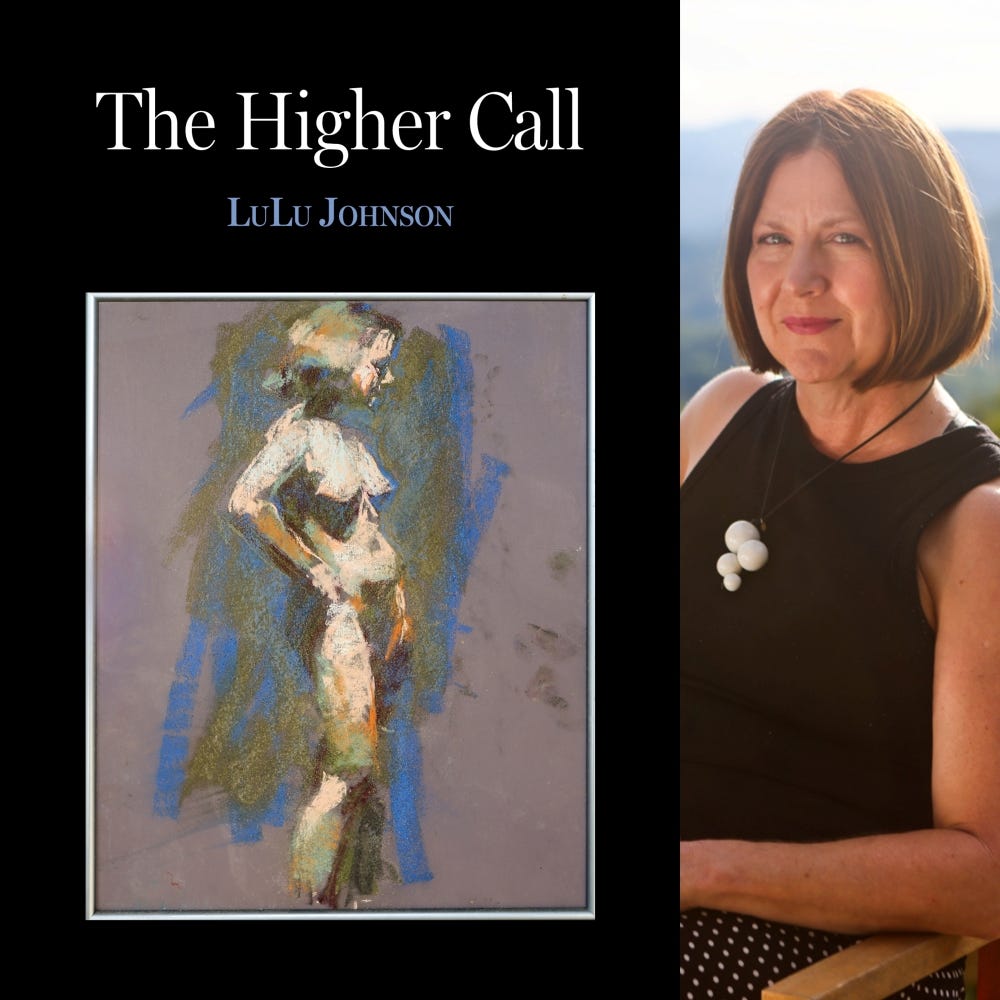
Those stories are what inspired me to write my debut chapbook of poems, The Higher Call. It started by looking at portraits Picasso had painted of his most famous models.
From my degree in Art History, I knew a little about his models. But not enough. I did some research and then wrote poems from the women’s points of view informed by my time on the model stand. The Hight Call also contains poems about my own modeling jobs, like the story you just read.
Pre-sales for the chapbook have ended, and I appreciate how supportive everyone was. If you ordered early, you have my deep gratitude. The chapbook will reach you in August, but today, please accept my thanks.
Next week, I’m going back to the Whitney Museum of American art to look at another Andy Warhol portrait—it’s wonderful and subversive, and very Andy.
As ever, thank you for following along on my journey in to print.
I like how the artists used blue/green in the "flesh." It's cool. You may have made the hand mistake for you but it makes for an interesting pose. Also like the way you've arranged your legs and feet - very characterful.