Above and Beyond
Or, Working My Way to the Top

Let’s hustle away from the worst modeling job I ever had to the best. This job was the best on every level—the students, the studio, and the pose. As we saw last week (sorry if it shocked!), those three elements profoundly effect the model.
Students come first. In my experience, models don’t start out working for the best artists. That is unless you’re Marie-Thérèse Walter, meet Pablo Picasso outside a Metro station, and start posing for him that day. Most models begin in beginning classes and work their way up to more talented artists. At least I did.
Working one’s way up requires being a good model. Good models are like any good employee—they’re on time, they don’t call in sick, and they do the job without complaint. Models also learn on the job—learn different types of poses, from 10-second gestures poses to ones that last for weeks (with breaks, of course!).
Yep, models do all that while being comfortably nude in a room full of strangers.
That’s the odd mix in good model’s personality. She has to be relaxed enough to be confident while unclothed, but also disciplined enough to be punctual and dependable. Somehow I was/am exactly that exact combination.
I learned fast because I modeled a lot. At one point in graduate school, I gave myself a little talking to, and it amounted to this: You’re in grad school to earn your MFA in poetry. You’re not in grad school to model.
After that, I cut back. I took fewer jobs, and I limited my area of influence—meaning, I quit driving outside the perimeter to work. The juice wasn’t worth the squeeze.
Focusing my efforts intown, I reached the pinnacle of the late 90’s Atlanta modeling scene. I knew I’d made it when I got booked to work for the most talented, professional, and sought-after portrait painter in town—Marc Chatov.
Marc taught a lot in Atlanta in those days. His classes were full of wildly talented students. Their paintings not only looked like the model, but they flattered her. Their work also vibrated with the type of insight that makes a portrait mean more.
My job was to be at the King Plow Art Center, Thursday evenings for 6 weeks. There I’d take the same pose for the same students with the same lovely classical music playing, for three hours a night. Honestly, I didn’t think a job could get better.
And then it did.
A circle of Marc’s students set up an intensive workshop. Instead of meeting for 6 consecutive weeks, they met for 6 consecutive days in a private home. They spent the mornings sketching different models, warming up. After a lunch served by a hired chef, they spent three hours painting one model. Me.
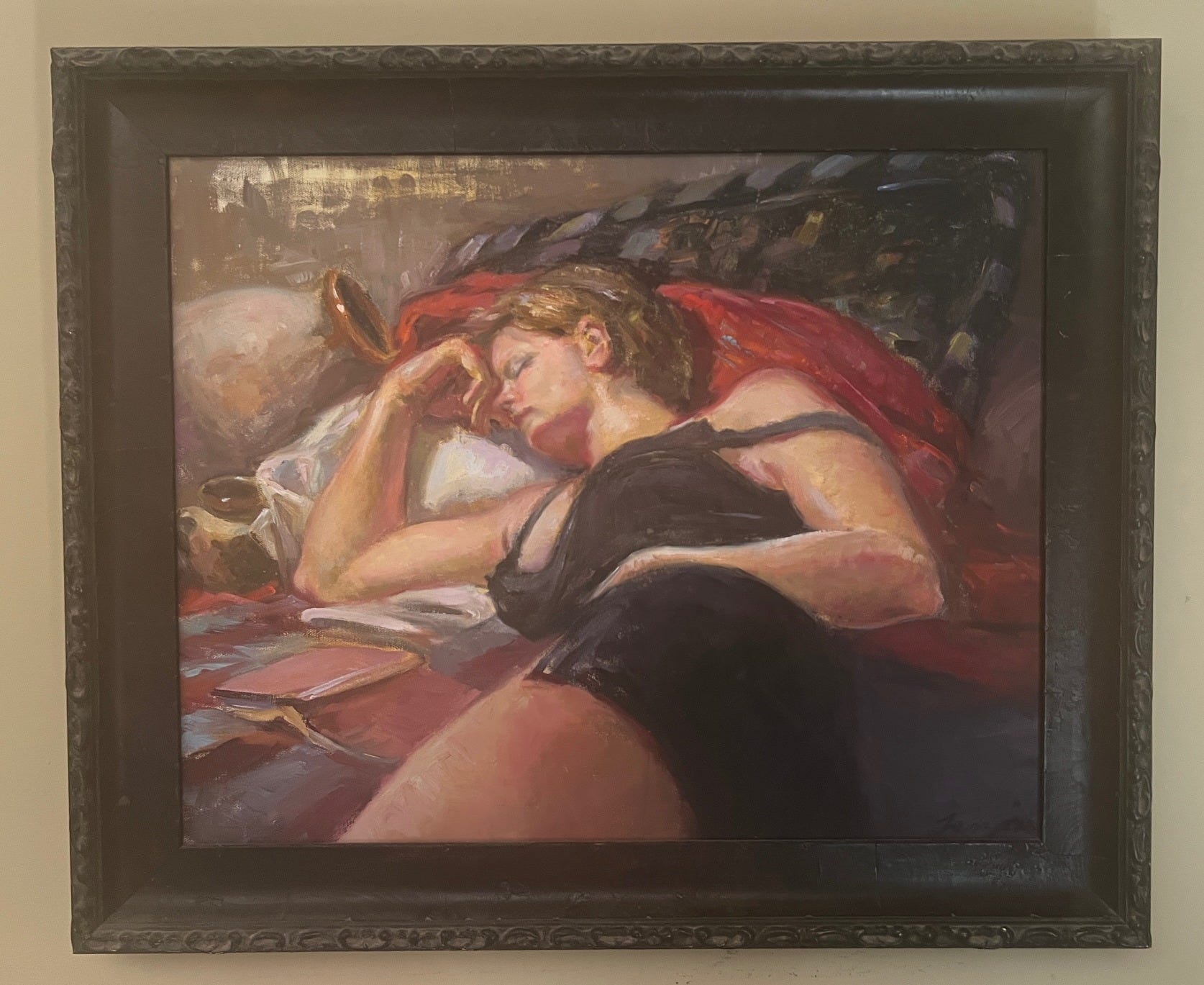
I knew the students from Marc’s classes, knew their names and called them friends. This time the studio was actually a lovely home in Buckhead. And the pose was entirely comfortable—I reclined amid pillows on a rug before a stacked-rock fireplace dressed in the homeowner’s own black slip.
The pose appeared so comfortable that students kept suggesting I go to sleep. What they wanted was for me to quit taking breaks so they could keep painting. But I’ve never been good at falling asleep on the job, in a room full of people, or half-dressed.
But it is funny to realize how *many* portraits of a sleeping Marie Thérèse that ol’ Pablo painted. He obviously liked the long pose, and she obviously needed a nap.
A few weeks after that week, I invited 2 of the artists to my 30th birthday party. There I was honored and gob-smacked when Diana Fenjack gave me her painting for my birthday present. As I recall, she wasn’t sure I would want it. Artists! So silly.
Who wouldn’t want this wonderful piece?
Looking at it, you can see Diane’s talent. She fit right in with Marc’s students—they all painted this well. Seriously. Modeling for them was a dream.
Somewhere between the two extremes—last week’s worst and this week’s best—is the space most modeling jobs occupy. The majority of instructors are professionals that treat the model with respect.
The majority of classes value the model’s comfort above their own—she gets the heaters pointed at her; she gets the pillows. And the majority of students appreciate what the model gives—her body over to their eyes so they can learn how to make art.
Next week, I’ll talk more about the actual art of posing and how my first BA in Art History wasn’t what prepared me for the job. Stay tuned for that.
Follow along for more about models and their artists, art history, poetry, and where these fields overlap—in the pages of my forthcoming chapbook, The Higher Call.
Order a copy here: Click this
As ever, thanks for following along on my journey into print.